
FOR IMMEDIATE RELEASE
5 June 2026
STATEMENT BY DAVID HAIGH, HUMAN RIGHTS LAWYER, IN RESPONSE TO DUBAI PUBLIC PROSECUTION
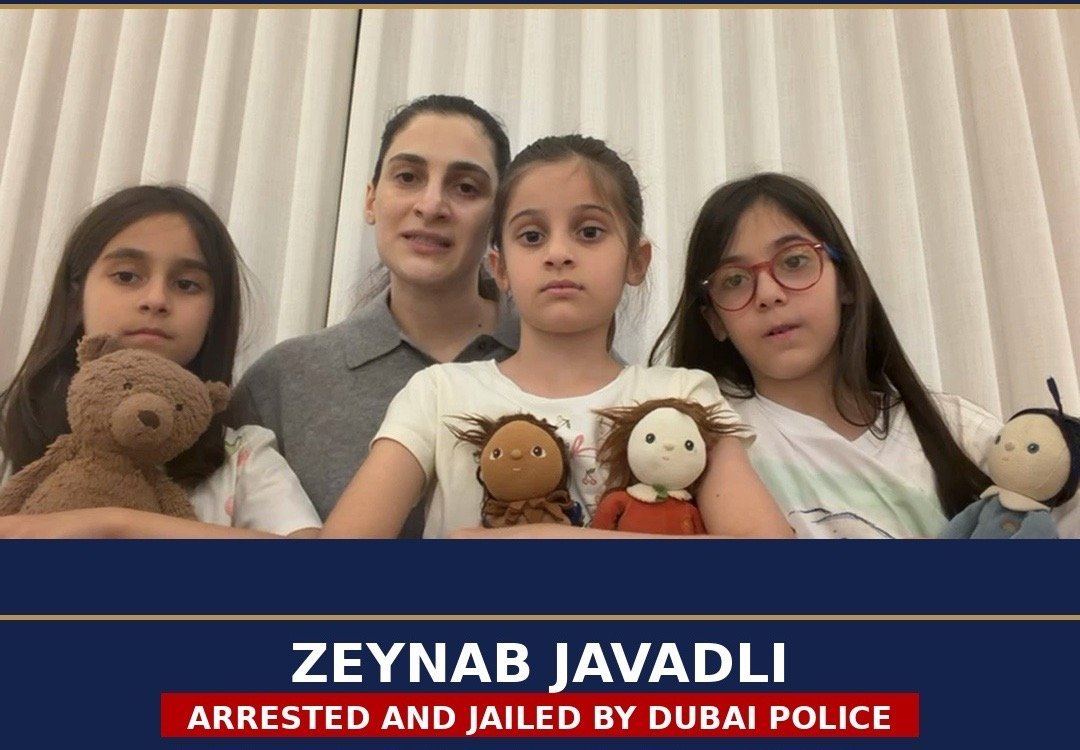
Dubai Public Prosecution statement: "Ms. Zeynab Javadli has been taken into custody, following a complaint filed by the father of her three children alleging that she abducted the children during a court-approved visitation session. The matter remains under investigation and is subject to ongoing legal proceedings."
Dubai Public Prosecution has today confirmed what Zeynab Javadli's family, lawyers, friends, and the Azerbaijani Consulate had repeatedly been unable to establish: that she is in custody. It should not have taken international media coverage, diplomatic enquiries, and worldwide public attention to obtain confirmation of something so basic.
The prosecution's statement alleges that Zeynab abducted her children during a court-approved visitation session. Let us be clear about what that means in practice. These are Zeynab's children. She is their mother. They have lived with her their entire lives, the eldest now almost ten years old. None of that matters, it seems, when your ex-husband is the powerful nephew of Dubai's ruler.
What the statement does not explain is why Dubai has suddenly chosen to act now. The incident being relied upon by the authorities did not occur yesterday. It did not occur last week. It occurred in November 2025. At the time, Zeynab was allowed to return home. She remained in Dubai. She was in regular contact with the Dubai authorities, including the Commander in Chief of Dubai Police, Abdullah Khalifa Al Marri, and had filed cases in both the Dubai and Azerbaijani courts. She was always accessible to the authorities. She continued caring for her children. Months passed. Now, more than half a year later, Dubai has decided to arrest her in the middle of the night, while she was alone with her children. Why? If this case is about the law, why was the law apparently dormant for seven months?
The 2022 Agreement
What Dubai's statement also omits is the extraordinary background to this case. In 2022, after years of highly publicised disputes concerning her children, Dubai's ruler Sheikh Mohammed bin Rashid Al Maktoum personally intervened in Zeynab's situation. She was granted full custody of her children. She was provided with a home and a driver. Most importantly, she was given a personal assurance that she would be protected in Dubai by the ruler and Dubai Police, and that she could continue living peacefully with her children.
In return, she withdrew complaints she had lodged with the United Nations and refrained from speaking publicly about her situation. Zeynab honoured that arrangement completely. She withdrew her complaints. She remained silent. She trusted the assurances she had been given at the highest levels of Dubai's leadership.
Whether one views that arrangement as compassionate intervention or something else entirely, its existence illustrates a reality that many expatriates in Dubai know all too well: outcomes are often determined not by transparent legal principles, but by influence, relationships, and discretionary power. Today, Zeynab finds herself on the opposite side of that same system.
A Question of Justice, Not Custody
People may disagree about the underlying custody dispute. That is not the issue. The issue is whether laws are applied consistently. The issue is whether legal rights can be granted, suspended, ignored, or revived according to the political convenience of the powerful. The issue is whether individuals can rely on the law in Dubai and the wider UAE at all. This is the weaponisation of a notoriously corrupt justice system by those in power.
And if there is any remaining doubt about what this case is truly about, consider this. Earlier this year, as bombs exploded across the region during the Iran conflict, Zeynab and her daughters were in Dubai. Not once, during that terrifying period, did the father call to check whether his children were safe. Not once. Not a single message. Not a single enquiry. Dubai authorities, so apparently consumed with concern for these children's welfare, showed no concern either.
These girls are not children to be protected. They are possessions to be traded. Their mother is not a parent to be respected. She is a complication to be removed, deported, and silenced. That is the reality behind this prosecution.
Dubai would like the world to view this as an isolated private family matter. It is not.
Dubai authorities used precisely that phrase before, when Dubai's ruler orchestrated the kidnap of his own daughter, Princess Latifa, and held her hostage for years. He was ultimately forced to release her only after a worldwide media and political outcry that played out in the English High Court, brought by his ex-wife Princess Haya, who had herself fled Dubai with her young children in fear of their lives. Princess Haya was fortunate. She escaped. She got out with her children and her life. Zeynab has not.
Zeynab's case is further evidence of a pattern that is now indisputable. The systematic abuse of women in Dubai, once a closely guarded secret, is plain for the world to see: women abducted, held hostage, silenced. The cases of Sheikha Latifa, Sheikha Shamsa, Sheikha Bouchra, Sheikha Randa, Princess Haya, and now Zeynab and her young daughters, Sheikha Sana, Sheikha Asiya, and Sheikha Salma, lay bare the brutal truth that Dubai so desperately tries to conceal behind expensive PR firms, paid celebrities, and influencers.
Those three girls are princesses of Dubai's ruling family. If this is how Dubai treats its own, imagine how it treats everyone else.
A Pattern Repeated
I currently represent another expatriate parent whose circumstances could hardly be more different from Zeynab's. He is an Italian businessman. She is an Azerbaijani former world champion gymnast. He is a father. She is a mother. He was married to a national from one of Dubai's most influential families. She was married into one of the most powerful ruling families in the region. Yet despite these entirely different circumstances, both cases point to exactly the same problem.
In 2022, my client obtained a Dubai custody judgment granting him custody of his young daughter after presenting extensive evidence that the court accepted in full. Days later, during the first visitation following that judgment, he took his daughter home in accordance with the custody order and on the advice of his lawyers. He was immediately accused of kidnapping his own child. The allegation was eventually dismissed. However, documents produced during the proceedings revealed a troubling chronology: the police paperwork indicated that key steps relating to the complaint had apparently been initiated before the alleged kidnapping was even said to have occurred.
Despite the dismissal of the allegation, despite the existence of the custody judgment, and despite his full cooperation with the authorities, the child was returned to the mother. The custody judgment was then overturned on appeal, during which a relative of the mother's family was initially found to have sat on the appellate judicial panel before being removed following objection.
That father was not a vulnerable migrant worker. He was exactly the kind of high-net-worth foreign investor Dubai spends billions of dollars trying to attract. Yet when his interests came into conflict with those of a deeply connected local family, he found himself describing precisely the same concerns now being raised by Zeynab. No matter how different the individual facts, both cases arrived at the same conclusion: in disputes involving powerful local interests, different rules appear to apply.
Foreign Governments Cannot Continue Looking Away
Zeynab's case raises uncomfortable questions for foreign governments. The standard response from consulates is that they cannot interfere in local court proceedings. Yet this answer becomes increasingly unsatisfactory when citizens are not complaining merely about an adverse judgment, but about the integrity of the system itself. Too often, foreign governments appear content to defer entirely to local processes, even where credible concerns exist regarding arbitrary enforcement, political influence, procedural irregularities, or unequal treatment. That silence has consequences.
The Children
The prosecution's statement says nothing about the fate of Zeynab's children. The eldest, Sana, is just days away from her tenth birthday. She had only just designed her own birthday cake. Where are the girls? How are they? What support are they receiving? What contact, if any, are they being permitted with their mother? Where is their beloved puppy, Milky? These are children who have spent virtually their entire lives in their mother's care, children who simply do not know the man listed as their father. The world is entitled to know how they are being treated.
Our Demands
We call upon the UAE authorities to grant Zeynab immediate access to legal representation. We call upon the Azerbaijani Government to secure immediate consular access. We call upon the authorities to provide clear information concerning the welfare and whereabouts of the children. And we call upon Dubai Public Prosecution to answer a simple question that sits at the centre of this case: if the events of November 2025 justified arrest, why was Zeynab allowed to remain free for more than half a year? Until that question is answered, it is difficult to avoid the conclusion that this case is about something other than the law.
Above all, we are calling on the UAE to release Zeynab immediately to her home in Dubai and to reunite her with her children. If there are allegations against her, let her answer them from her home, with her children beside her, with proper legal representation, and with the basic dignities that any human being deserves. Not from a dangerous, squalid jail cell where she has no access to her lawyers, her family, her friends, or even adequate food. That is not justice. That is the punishment of a devoted mother and her children, punishment without crime and without trial.
The world is watching. It will not look away.
#ZeynabJavadli #FreeZeynab
David Haigh
Human Rights Lawyer to Zeynab Javadli and Co-Founder, Dubai Watch
For media enquiries:
David Haigh
+44 (0)7 888 217 777
david@davidhaigh.co.uk
press@dubaiwatch.org
Aisha Ali-Khan, Co-Founder Dubai Watch
+44 (0)7 718 990 706
Aali@dubaiwatch.org
ENDS